
Atlantic City Previous Residents by Era
Tracing past residents starts by assigning each source a job. For an Atlantic City property, county deed records follow title transfers and recorded party roles. City directories, census schedules, and newspapers can show historical household or address presence. Atlases and Sanborn maps explain the physical setting. Probate files may identify an executor, heir, or estate-property connection. None of those is a universal list of everyone who ever stayed at a property. Together, they produce a source-labeled sequence that is more useful and more honest than a single untested name match.
| Source | Years it covers | Where held | What it shows |
|---|---|---|---|
| County deed index and images | County-era records; online images begin March 2000 | Atlantic County Clerk | Title-transfer parties, legal descriptions, and linked instruments |
| County index books | 414 back-scanned books; year varies by book | Clerk search and office | Role-coded party index and instrument trail |
| Recorded maps and tax maps | More than 9,500 back-scanned maps | County Clerk and GIS | Lots, subdivisions, map references, and parcel relationships |
| Atlantic City directories | 1872-1982, incomplete but extensive | Heston Archives | Name, address, business, and publication-year context |
| Federal and New Jersey censuses | Federal years 1840-1930 listed by Heston; state years 1855-1915 at intervals | Heston and archives resources | Enumeration-time household and place context |
| Sanborn maps and atlases | Sanborn 1886-1952; atlases 1885-1924 | Heston and Library of Congress | Building, street, numbering, and map-era context |
Start with the period that is known. For an Atlantic City property with a known twentieth-century owner, begin with the clerk’s index. A nineteenth-century household question may begin with a Heston directory and an atlas. A missing source does not close the trail. It identifies the next custodian, year range, or record key to pursue.
Atlantic City Previous Residents in Deed Chains
The Atlantic County Clerk public-records search is the title-history route. It handles party names with automatic wildcards and spelling variations, and supports a second-party search, document type or group, date range, Book and Page, clerk file number, consideration, Town, Lot, Block, Map Number, and linked documents. For a difficult Atlantic City address, the legal Town, Lot, Block, or Map Number can be stronger than a street string. An Atlantic City deed-chain search should record the instrument’s date, document type, party role, and legal reference at every step.
The official clerk index shows the search interface used for the recorded-land trail.
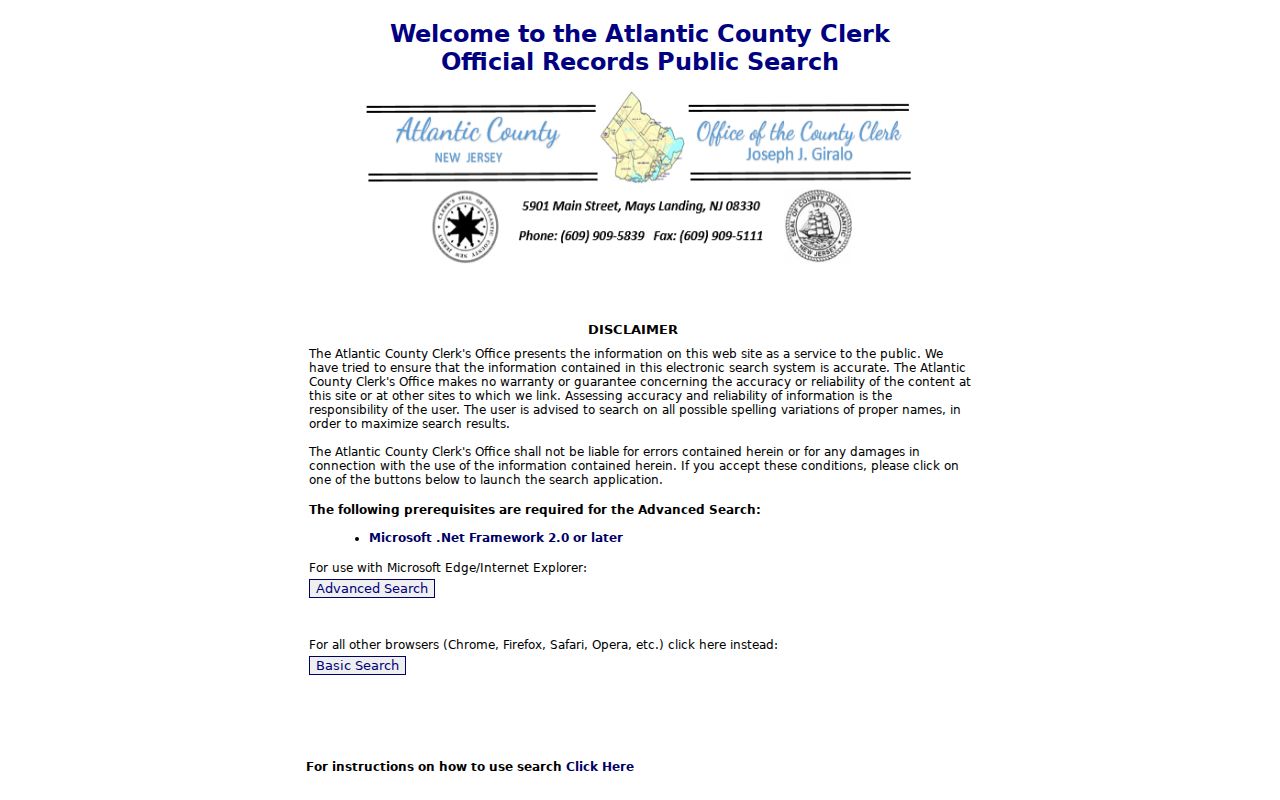
The screen supports an index search, but an indexed party is not automatically a past occupant. Follow the record type and legal description before pairing the result with a directory or census source.
- Confirm the current street address, parcel, and block and lot through assessment or GIS material, while noting the source date.
- Find the current title holder’s acquisition record in the clerk index and save the document type, recording date, and legal reference.
- Search the seller’s earlier acquisition as a grantee, then repeat backward through the recorded transfer sequence.
- Use linked documents and the Town, Lot, Block, or Map Number route when a party name or street string is ambiguous.
- Keep Book and Page for pre-March 1, 2000 records, or Instrument Number for later copy requests, before moving to household sources.
Atlantic City Previous Residents and Party Roles
Atlantic City deed records answer a title question, not every household question. A grantor transfers an interest. A grantee receives one. A mortgagor gives a mortgage, while a mortgagee receives the security interest. The index can also name a trustee, executor, release party, or corporate party. Those roles are vital evidence, yet none should be rewritten as proof that a person lived at the property. A directory subject, census household member, and obituary subject each make a different historical assertion.
- Grantor and grantee
- The grantor is the recorded transferor; the grantee is the recorded recipient. Record the role exactly as indexed.
- Chain of title
- A sequence of recorded instruments that connects transfers of an interest in the property. It needs dates and legal references, not just matching names.
- Legal description
- The lot, block, town, map, or other recorded property description. It can remain stable when a street label is unclear.
- Instrument number
- The later-record copy key used by the Atlantic County Clerk after the March 1, 2000 online-image boundary.
Note: Preserve party role, source date, and document type before connecting a title record to any household or address record.
Atlantic City Previous Residents and Missing Images
Atlantic County’s index is free to guests, updated daily, and older than the available online images. Images beginning March 1, 2000 are viewable online, while earlier imaging is being added through back-scanning. The county reports that all 414 index books have been scanned, along with more than 9,500 recorded maps and tax maps. It also reports an Atlantic County Record Newspaper backscan from 1864 to 1967. Those numbers make an older Atlantic City trail more workable, but they do not mean that every deed image is already online.
When the index gives a deed but no image, preserve the result row. An Atlantic City researcher should write down the Book and Page for pre-March 1, 2000 documents or the Instrument Number for later ones, plus the recording date, party roles, and legal description. The clerk’s recorded-document copy instructions describe the official copy route. The research identifies copies at $2 per page with an additional $5 for certification. That is the documented next step, not a reason to treat an image gap as a missing property history.
Atlantic City Previous Residents in Directories
The household layer begins at the Heston Archives. Its incomplete but extensive city-directory collection spans 1872 to 1982. Entries may include a name, occupation or business, street address, and sometimes a spouse or household signal. Compare two adjacent editions before calling a line a move. A person can be missed through a spelling variation, an incomplete run, a regional label, or a publication choice. The volumes themselves are described in detail on the Atlantic City city directory page.
Federal census schedules listed at Heston include 1840, 1850, 1860, 1870, 1880, 1900, 1910, 1920, and 1930, plus the 1890 Civil War veterans and widows special schedule. New Jersey state census years are 1855, 1865, 1885, 1895, 1905, and 1915. Census material captures an enumeration-time household, not a claim of permanent residence. Newspaper runs can add a move notice, obituary, sale, business event, or civic reference, but their address language can be temporary or mistaken.
Use this short household flow: directory year and page, then census year and household context, then newspaper date and wording, then the related deed or map key. The sequence is easier to test because every source keeps its own date and purpose.
Atlantic City Previous Residents on Sanborn Maps
Sanborn maps and atlases keep an address grounded when a directory uses an old street form or a building changed over time. Heston holds atlases from 1885 to 1924 and local Sanborn coverage from 1886 to 1952. The Library of Congress 1896 Atlantic City Sanborn gallery provides 65 public-domain images. An Atlantic City sheet can show street names, building footprints, construction materials, use labels, room arrangement, or numbering conventions. It is not a modern parcel survey or a substitute for a legal description.
Compare cross streets, a building footprint, and any printed number before treating an old directory address as the modern one. Then test the relationship with the county clerk’s legal description or a recorded map. Cite the map sheet and year with the directory year. That leaves a clear record of what the map actually supports and avoids turning a visual match into an unsupported statement about a person.
Atlantic City Previous Residents and Old Labels
Historical place names can redirect an Atlantic City address search. The Heston holdings include Gopsill’s volumes that name Atlantic City, Longport, and South Atlantic City, while other identified editions include Chelsea. Those labels were accurate for their publication scope. They are not interchangeable with a present municipal label. Record the original place printed in the directory, compare it with an atlas or Sanborn sheet, and only then consider whether a current parcel search belongs in the same place.
County records add another local routing detail. Atlantic County’s county seat is Mays Landing, even though the clerk has an Atlantic City satellite at 1333 Atlantic Avenue. The main recording office is at 5901 Main Street in Mays Landing, where documents and fees are delivered. The county-seat split matters when an older index result needs a copy request or office follow-up. It does not change the historical address; it changes the custodian route.
Atlantic City Previous Residents and Estate Files
The Atlantic County Surrogate’s Office is a possible endpoint when a historic owner or directory subject died, left an estate, or appears as an executor. It holds wills, probate, estate administration, guardianship, trust, adoption-related, and related filings. Public inspection is available to title searchers, genealogists, and the public, subject to the status and limits of the record. An estate file may identify a decedent, executor, heir relationship, or property clue, but it is not a current household list.
Atlantic County was formed in 1837, and the New Jersey State Archives can supply a wider historical route when county or local materials stop. Its collection guidance includes older deed, mortgage, will, inventory, naturalization, and name-change series. Keep a past-resident conclusion narrow: state the source, the record role, the date, the property reference, and the next gap. That lets another family historian or property researcher recheck the trail.